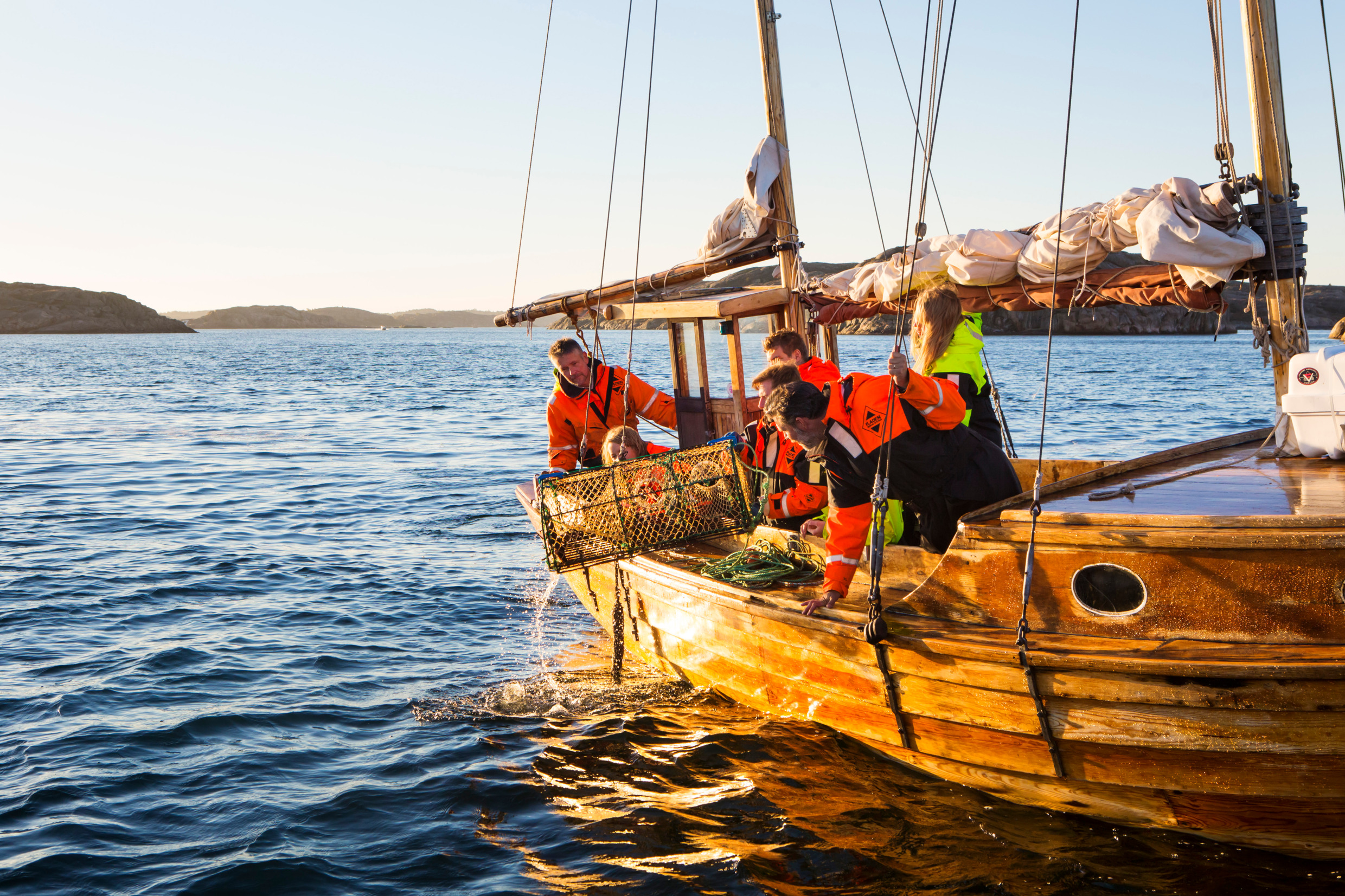
A group of people stand on a fishing boat and watch a person pull up a lobster trap.
Lobster safari, West Sweden
Join a lobster safari with professional fishermen using lobster pots. Lobster pots are the only allowed way to catch lobster in Sweden.
Photo credit: Roger Borgelid/imagebank.sweden.se

Swedish seafood safaris – from lobster and crayfish to oysters and seaweed

Whether you’re hauling lobster pots, fishing from a jetty, harvesting mussels or snorkelling for seaweed, a seafood safari on Sweden’s west coast lets you get hands-on with the local catch. Head out on the water with local fishers and guides and discover a side of Swedish seafood that goes well beyond what’s served on the plate.

A seafood safari here brings you closer to both the catch and the coastal landscape, and is as much about the experience as what eventually ends up on your plate. Sweden has plenty of these culinary adventures, both on the water and on land.

Along the coast of West Sweden, local fishers and guides invite you to try traditional fishing and harvesting methods and learn more about the seafood that has shaped the region’s food culture.

From crab fishing off a jetty to heading out to sea in search of lobster, langoustines and mackerel, there are plenty of ways to get involved. Here are some classic seafood experiences to try on Sweden’s west coast.

1 / 3

Crab fishing

Crab fishing by the Nordic Watercolour Museum in Skärhamn, on the island of Tjörn. The archipelagos of West Sweden are vivid, with anything from museums to seafood safaris to explore.

Photo: Anna Hållams/imagebank.sweden.se

/ 3
Crab fishing

Crab fishing

Photo: Anna Hållams/imagebank.sweden.se

Closeup of a hand holding up a small crab by pinching it between thumb and index finger.

Fishing for crabs

Photo: Aline Lessner/imagebank.sweden.se

Langoustines, crayfish, is lying in a basket and you see that someone is pouring more seafood into the basket.

Langoustine

Photo: Tina Stafrén/imagebank.sweden.se

Crab fishing – a west coast classic

Crab fishing is a classic summer pastime on Sweden’s west coast, and you’ll see children and adults trying their luck from jetties all along the coast. It’s easy to have a go yourself: all you need is a line with a clothes peg, some bait (a prawn, a mussel or a piece of sausage will do) and a bucket for your temporary catch. Remember to gently return the crabs to the sea once you’re done.

To take your crab fishing up a notch, head out to sea with a local guide. Kastor Boat Trips runs crab fishing trips from the island of Hönö from April to September. Join a two-hour trip or opt for an experience that pairs the fishing with a three-course seafood dinner, with your catch served as the starter.

Catch your own langoustines

Langoustines thrive on the muddy seabed at depths of around 30–40 metres. While they are commonly caught by trawlers, fishing with pots offers a gentler alternative. Pot-caught langoustines tend to be less muddy and are often considered tastier.

From April to July, Marine Events runs langoustine fishing trips in the waters around Hönö. Once the pots are hauled aboard, you’ll help remove the catch and add fresh bait before the pots are lowered back into the sea. You’ll even get to take home some of the catch.

1 / 2

Lobster safari

Lobster safari with professional fishermen using lobster pots. Lobster pots are the only allowed way to catch lobster in Sweden.

Photo: Roger Borgelid/imagebank.sweden.se

/ 2
A group of people stand on a fishing boat and watch a person pull up a lobster trap.

Lobster safari

Photo: Roger Borgelid/imagebank.sweden.se

Lobster

Lobster

Photo: Henrik Trygg/imagebank.sweden.se

Mackerel fishing – a summer favourite

Mackerel is a sure sign of summer in Bohuslän. The fish arrive along Sweden’s west coast towards the end of May to feed and spawn, often swimming close to shore. A favourite among both recreational fishers and seafood lovers, mackerel remains a firm fixture of west coast summers.

From late May to September, Hönö Båtturer takes visitors out to fish for mackerel in the waters around the islands of Fotö and Vinga. This family-friendly trip gives you the chance to fish with rods alongside a professional fisher, sometimes catching just a few, sometimes several at once. You’ll also learn how to gut and prepare your catch, which is yours to take home.

On the hunt for lobster

The lobsters found in these Swedish waters are often referred to as “black gold” – considered some of the best in the world. The harvesting season for this delicious breed of shellfish starts the first Monday after 20 September each year – and you’re invited to join this much-anticipated calendar highlight. Setting off from the iconic seaside spot of Marstrand, you’ll be boating around the rocky islets, accompanied by experienced guides who’ll be happy to chat all things lobster.

Fiskahummer.nu is a well-established lobster safari organiser offering crayfish and crab fishing adventures. While out at sea, you’ll undoubtedly catch other fish too – most likely cod, saithe and mackerel. These fishing experiences can be combined with packages including accommodation and dinner at the atmospheric boathouse. You can also add options like tasting sessions and cooking activities to your tailor-made package.

1 / 3

Mussel harvesting

Experience a mussel safari where you can learn more about mussels, how to harvest them and how to cook them in the best possible way.

Photo: Erik Olsson/imagebank.sweden.se

/ 3
A group of people hold freshly caught mussels.

Mussel harvesting

Photo: Erik Olsson/imagebank.sweden.se

On a wooden table lies an oyster along with a glove two knives.

Oyster kit

Photo: Madeleine Landley/Westsweden

A person in a wetsuit, sitting on a cliff, looking a different types of seaweed. A pair of fins in the foreground.

Seaweed safari with Catxalot

Photo: Tina Stafrén/imagebank.sweden.se

Harvest mussels and oysters

The cool, salty waters along Sweden’s west coast provide ideal conditions for mussels and oysters, and a guided trip offers the chance to see first-hand how they are grown and harvested.

From March to November, Lysekils Ostron & Musslor takes you out from Lysekil aboard Signe, a 1950s fishing boat. First stop is a mussel farm, where you’ll learn about mussel farming and help harvest the shellfish. The trip then continues to an oyster bank, where Ostrea edulis is grown – a variety known locally as the ‘Swedish oyster’.

With the day’s harvest on board, you’ll head ashore on a small island to cook the mussels, open the oysters and enjoy your freshly harvested seafood for lunch.

Forage for seaweed

Fish and shellfish aren’t the only delicacies found in Swedish waters. Some 300 types of seaweed grow here, at least 20 of which are edible – adding another dimension to a seafood safari.

From June to August, Catxalot offers seaweed foraging experiences in Grebbestad and Grundsund. Equipped with a mask and snorkel, you’ll head into the water and learn to identify and harvest eight to ten different types of seaweed. You’ll also discover how to dry and store your harvest, and how to use it to prepare a meal. Catxalot also offers cooking classes and other seaweed experiences for those keen to delve deeper.

Part of the appeal of a seafood safari is never quite knowing what the day will bring. The catch changes with the seasons, but the chance to head out to sea, learn from the people who know these waters and enjoy the day’s catch makes each trip a genuine way to discover Sweden’s west coast.